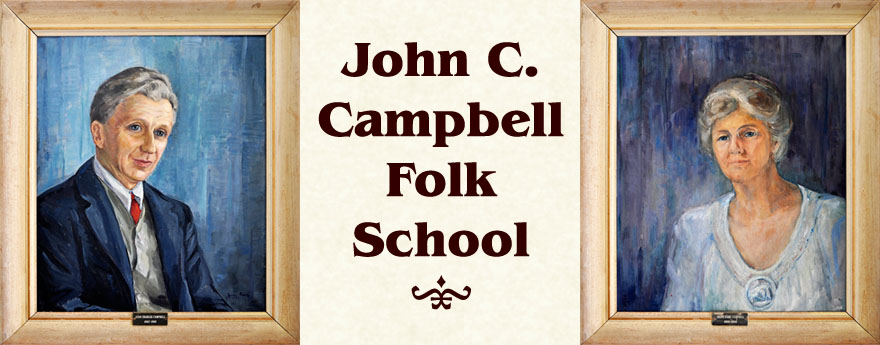
From 1908–1909 John C. Campbell and wife Olive undertook a fact-finding survey of the social conditions in the Southern Appalachian and Blue Ridge Mountains from Georgia to West Virginia, living their life on the road in a covered wagon fashioned for their personal needs. John born in Indiana and raised in Wisconsin studied education and theology in New England and felt a calling for humanitarian work. The turn of the 20th century offered John and Olive the opportunity to do research in the Southern Appalachian region, a vast area of the southeastern United States that was viewed at the time as a fertile field for education and social missions.
During their journey John would interview farmers about their agricultural practices while Olive collected ancient Appalachian ballads and studied the handicrafts of the mountain people. Together they were hopeful that the quality of mountain life could be improved by education and in turn preserve and share with the rest of the world the wonderful crafts, techniques and tools that the mountain people used for their everyday needs.
The Campbell’s talked of establishing a type of “folk high school” such as the “schools of life” known to the Danish as “Folkehojskole.” This educational system had transformed the Danish countryside into a vibrant, creative force.
Sadly John died in 1919 without seeing his vision come to life. After his death Olive and her friend Marguerite Butler traveled to Europe to study Folk Schools in Demark, Sweden and other countries. Returning to the United States these two dynamic and adventurous ladies sought out an ideal location for at Folk School.
They knew that they could not simply impose their ideas on the hard minded mountain people without developing a genuine collaboration with locals in the community. During one exploratory trip to Brasstown, North Carolina Mrs. Butler discussed the idea with Fred O. Scroggs, a local storekeeper. A few weeks later she returned to find a meeting of over 200 people brought together in her honor to discuss building a Folk School in their community. For the development of the new Folk School the Scrogg’s family donated 75-acres of land while local residents pledged labor, building materials and other support.
In 1925, the Folk School began its work. Instruction at the Folk School has always been non-competitive; there are no credits, no grades no pitting of one individual against another. This method of teaching is what the Danes called “The Living Word.” Discussion and conversation, rather than reading and writing, are emphasized and most instruction is hands-on.
Since its first opening over 85-years ago the Folk School has grown along with its vision offering more classes than seemed possible since its founding in 1925. Today the John C. Campbell Folk School rests on a sprawling 300-acres of rolling meadows and forest, with a school campus that flows with the landscape containing roughly 30 buildings composed of both historic and newly constructed, maintaining a countryside ambiance that is conducive with its mountain and valley theme. In some cases the buildings look nearly as rustic as their history, though they are quite cozy and comfortable with each classroom studio carrying its own theme such as, pottery, jewelry making, kaleidoscope construction, bamboo fly rod making, woodcarving, woodturning, painting, photography, folk dancing, instrument making, blacksmithing and gardening to mention only a few. To order their latest class catalog, use this link
https://www.folkschool.org/Catalog/catalog-request.shtml .
The campus site of the historic John C. Campbell Folk School offers a study atmosphere like that of a serene farm setting that is quiet and tranquil, a place to open your mind and spirit. There’s a natural humility about the Folk School that characterizes mountain hospitality, friendliness and fellowship amongst its students and school staff. The yearly Fall Festival at the Folk School is the largest festival in Western North Carolina and one not to miss.
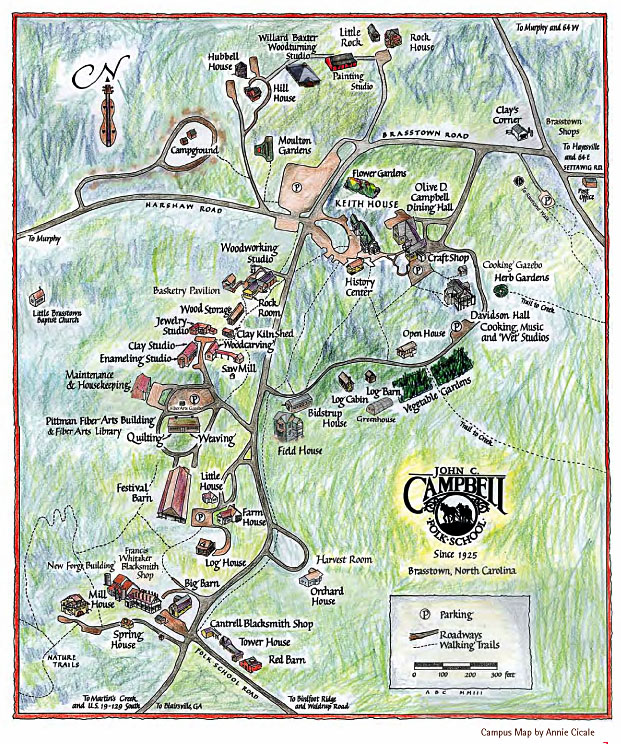
Photos of Clay, Blacksmith, Fiddle Classes and campus map, courtesy of John C. Campbell Folk School.

Sign
up for the Blue Ridge Highlander Newsletter, Messages from the Mountains
to find out first about our new feature stories, road trips and special offers
Your e-mail addresses will not be sold or given away to anyone.
Privacy
Policy
Interested in your business being on the Highlander, click here...
Let our visitors tell you about the Highlander...
Click the feathers to go to the Highlander site
map...
Your e-mail addresses will not be sold or given away to anyone.
Let our visitors tell you about the Highlander...
Click the feathers to go to the Highlander site
map...
Highlander Special Interests
Great Mountain Attractions and Destinations Links to All Highlander Advertisers
Blue Ridge Highlander Mountain Emporium Art Gallery Photo Gallery Handmade Products Book Store
Magazine, Virtual Tours and Scenic Road Trips Creative Mountain Classes Just for Kids
Living Green and Eco Friendly in the Mountains Gardening in the Mountains Mountain Recipes
Mountain and Native American History Nathanael O. Smith - Storyteller Mysteries, Myths and Legends in the Mountains
Mountain Cathedral Charities and Fundraisers
Great Mountain Retreats
Adventure • Art • Cooking • Corporate • Family • Friend • Yoga • Wellness • Youth
Learn More About the Towns and Cities in the Mountains
North Georgia Mountains Western North Carolina Mountains
Up Country South Carolina Tennessee River Valley and Mountains
Great Smoky Mountains Blue Ridge Parkway
Move to or Invest in the Mountains
Real Estate • Log Homes • Cabins • Homes • Land • Acreage • Commercial Real Estate
North Georgia Mountain Real Estate Western North Carolina Real Estate
Tennessee River Valley and Smoky Mountain Real Estate
Interior Design and Furniture Shops Schools in the Mountains
Traveling • Living • Enjoying the Mountains
Log Cabin Rentals • Vacation Rentals • Resorts • Condos • Inns • Hotels • Bed and Breakfasts
Luxury Resorts and Spas in the Blue Ridge and Smoky Mountains
North Georgia Mountain Lodging Western North Carolina Lodging Tennessee River Valley Lodging
Plan a Mountain Wedding or Gatherings Conference, Meeting and Retreat Facilities
Vineyards • Wineries • Tasting Rooms Agri-Tourism Farmer's Markets
Yoga Retreats • Spas in the Mountains
Events and Festivals in the Mountains Theatre • Concerts • Mountain Entertainment
Restaurants, Dining and Catering in the Mountains
Shopping in the Mountains Blue Ridge Highlander Mountain Emporium and Art Gallery
Artists, Art Galleries and Art Associations in the Mountains Museums, History and Culture in the Mountains
Family Fun in the Mountains Just for Kids
Adventure and Outdoor Fun in the Mountains
Mountain Adventure Horseback Riding, Stables and Trails Mountain Bike Trails
White Water Rafting and Adventure Zipline • Canopy Tours Fishing in the Mountains
Boating and Marinas Camping and RV Parks ORV Adventures
Scenic Mountain Drives Mountain Golf Courses Mountain Day Use and Picnic Areas
National Parks in the Mountains National Forest Service in the Mountains State Parks in the Mountains
Waterfalls in the Mountains Lakes in the Mountains Rivers, Creeks and Trout Streams in the Mountains
Nature and Wildlife in the Mountains Mountain Birding Hiking Trails in the Mountains
More Information
Home Site Map Advertise on the Highlander Link to the Highlander Contact the Publisher
designed, produced and hosted by